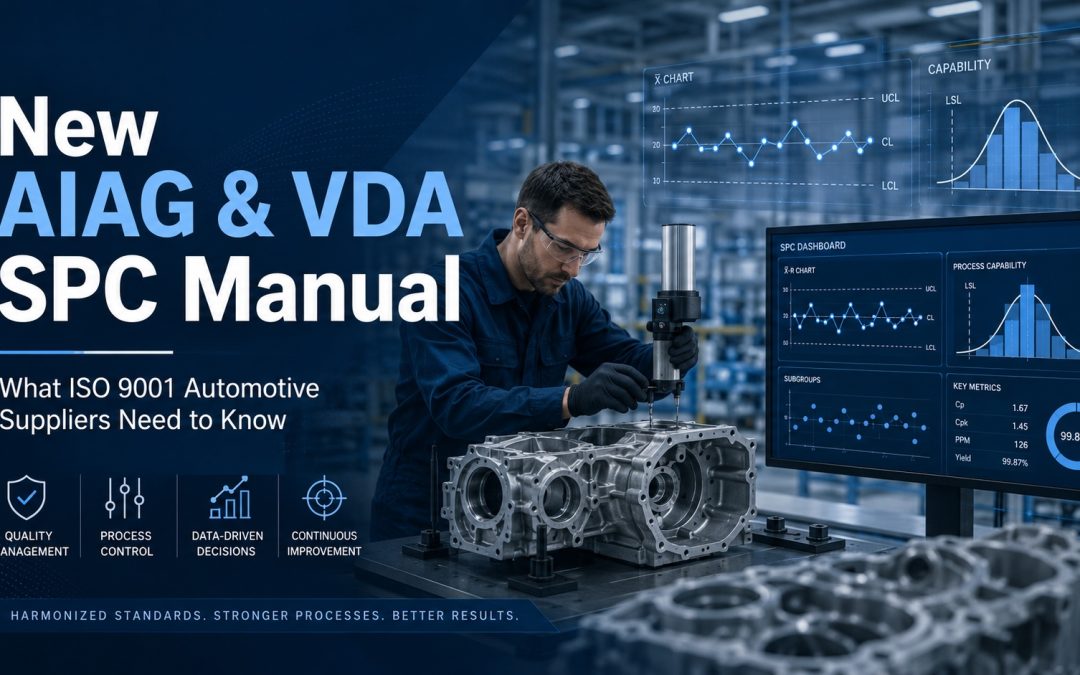
What the New AIAG & VDA SPC Manual Means for ISO 9001 Automotive Suppliers

What the New AIAG & VDA SPC Manual Means for ISO 9001 Automotive Suppliers

AIAG and VDA have released their first harmonized Statistical Process Control manual. For ISO 9001-certified automotive suppliers, the main issue is not whether ISO 9001 changed. It did not.

The issue is whether automotive customers will require suppliers to use the new manual.

Will customers invoke it?

Many probably will through supplier quality manuals, PPAP requirements, purchase orders, contracts, drawings, or customer-specific requirements.

Suppliers should check whether each customer requires:

  • A specific edition;
  • The “latest edition”;
  • Implementation on new programs only; or
  • Approval before changing an existing Control Plan.

Do not assume that every current SPC method must be revised immediately. Customer requirements and transition instructions control usage requirements.

What has changed?

The manual places SPC within the broader quality management system rather than treating it as a stand-alone charting activity.

Key changes include:

  • Alignment with ISO 22514 and ISO 11462;
  • Greater emphasis on machine capability and performance studies;
  • Expanded guidance for selecting control charts;
  • More attention to non-normal and time-dependent processes; and
  • Support for percentile-based and z-score-based capability methods.

The manual gives suppliers more statistical options, but it also requires better justification for the methods selected.

Using an X-bar and R chart simply because it is familiar may no longer be defensible.

Will sampling change?

Possibly. The manual primarily affects sampling used for SPC and capability studies, not acceptance sampling.

A fixed practice such as checking five parts every two hours may not represent a process affected by:

  • Tool wear;
  • Multiple cavities;
  • Different spindles or fixtures;
  • Material changes;
  • Temperature;
  • Shift changes; or
  • Process drift.

Sampling should reflect how the process actually varies. Customer-required sample quantities still apply.

Is the manual more flexible?

Statistically, yes.

Suppliers can select methods suited to the process and data rather than forcing every process into the same chart or normal-distribution model.

Operationally, it may feel less flexible because the supplier must explain why the selected chart, sample size, interval, distribution, and capability method are appropriate. (You may want to have your favorite AI assist you in writing this explanation)

More choices require greater competence.

What should suppliers do now?

Review customer requirements, obtain the new manual, perform a gap assessment, and identify every current SPC application that may be affected.

Focus first on control-chart selection, sampling rationale, capability methods, reaction plans, software calculations, and employee competence.

The new manual does not automatically change ISO 9001 requirements. Customer flowdown will determine whether it becomes mandatory for your business.

Sources: AIAG & VDA SPC Manual, AIAG publication information; ISO 22514; ISO 11462.

ALERT: Beware of ISO 9001:2026 Training Scams

ALERT: Beware of ISO 9001:2026 Training Scams

Richard C. Randall has been in the Quality Profession for over 30 years, and is a Probitas Authentication certified AS9100:2016 “Aerospace Auditor” Certification Number: 1619032756. Randall has performed over 2,000 quality management system audits for multiple world-class Certification Bodies.

Currently, ISO 9001 is in a draft stage, and discussions about its upcoming revision are circulating. Much of this chatter is speculative and based on unofficial sources (e.g., rumors, gossip). While speculation about potential changes is normal, charging fees for training courses that claim to cover “what will be in the revised standard”—when the standard’s content is still under development—is misleading and, frankly, a scam.

What We Know So Far:

1. What will be included in the upcoming revision?

The truth is, no one knows for certain. The committee working on the revision is still actively developing it. The “Committee Draft 2” (CD2) is about to be released, and may undergo further revisions (CD3, CD4, etc.) before progressing.

Once the committee approves a Committee Draft, it will move to the “Draft International Standard (DIS)” stage—initially DIS 1—and may be revised multiple times (DIS 2, DIS 3, etc.) before final approval.

Historically, some publishers have released books ISO 9001:2000 or ISO 9001:2015 based on a DIS, aiming to be first to market. However, these early publications often contained inaccuracies due to last-minute changes before the final standard was released.

2. Are we sure that the revision incorporate updates from ISO Annex SL, Appendix 2?

It’s highly likely that the new ISO 9001 will include all of the elements of ISO Annex SL, Appendix 2, which provides the high-level structure, terms, and core definitions. However, this is not guaranteed—especially since Annex SL, Appendix 2 is currently at Rev. 4, and is subject to change before the final standard is issued.

Expectations should be tempered; updates may add, modify, or remove certain requirements once the revision is finalized.

3. How can you stay prepared without falling for scams?

Be cautious of webinars or courses that use fear tactics or hype to persuade you to enroll. Remember, transitioning to a new standard typically provides a minimum of three years—plenty of time to adapt your systems.

The consensus is that ISO 9001:2026 will be a minor revision, focused on clarifications and structural updates rather than fundamental changes. So any changes should be relatively simple to adopt.

======

While the page is poorly maintained, you can monitor the official ISO committee page for ongoing updates, here:

[ISO TC 176/SC 2 News & Updates](https://committee.iso.org/sites/tc176sc2/home/news/content-left-area/news-and-updates/Update%20-%20Revision%20of%20ISO%209001.html)

Stay informed through official channels and avoid falling prey to misinformation or opportunistic training scams.